Why China books differently
First published
Updated
Trip.com, Ly.com and the travel brands that change meaning across borders
Mainstream does not mean risk-free. Unfamiliar does not mean fraudulent. A travel site can look like an unfamiliar discount intermediary in one country and be part of everyday booking infrastructure in another. China's travel platforms show why brand recognition, distribution and booking risk need to be separated.
The unfamiliar name is not the whole story An American traveler encountering Ly.com in a flight-price comparison may reasonably ask who is behind it. A Chinese traveler may recognize the same name as 同程旅行, Tongcheng Travel, a business encountered through an app or inside Weixin. The difference is not evidence that one traveler is sophisticated and the other naive. They have seen different parts of the same market. Ly.com's own corporate page identifies the domain with Tongcheng, while Tongcheng's investor site describes a Hong Kong-listed travel platform offering transport tickets, accommodation and other travel services. [1][2]
That contrast supports a narrower and more useful argument than "the cheap sites are actually all trustworthy." Some unfamiliar names belong to substantial businesses. Some are different storefronts within a larger group. Others still require separate investigation. A brand's domestic scale can establish that it is not an obscure, newly invented operation; it cannot establish that a particular fare has been issued correctly, that a refund will be easy or that a customer-service interaction will go well.
The distinction matters because "trusted" often compresses several separate questions. Does the business exist? Is it widely used? Is the payment page genuine? Are the ticket conditions suitable? Who can fix a disruption? Those questions require different evidence. A stock-exchange filing answers the first two much better than the last three. This essay treats mainstream status as a matter of identity and distribution, not as a safety certificate.
Ly.com is Tongcheng, not a random two-letter booking site Tongcheng Travel's corporate profile says the group listed in Hong Kong in November 2018 under stock code 0780.HK. Its services extend beyond bargain flights to transportation ticketing, accommodation, attraction tickets, packaged tours, hotel management and ancillary products. That breadth is important: an overseas traveler seeing one airfare result is seeing a small slice of a domestic travel business, not necessarily its main consumer identity. [2]
The scale is measurable, with qualifications. In its 2026 interim report, Tongcheng reported 253.9 million annual paying users for the twelve months ended June 30, 2026. It also said more than 87 percent of registered users lived outside China's first-tier cities. These are the company's reported metrics, not an independent survey of customer satisfaction. The paying-user figure is not a count of people who endorse the company, and registered users are a different population from paying users. Nevertheless, the figures make the idea of a marginal, unknown operation difficult to sustain. [3]
Even the domain can mislead a reader without local context. The English letters do not announce the Chinese brand to someone who has never encountered it. Ly.com's own mobile "About" page explicitly links the site to Tongcheng, but that page contains older milestones and scale figures. It is useful for the identity connection, not for a current market-size claim. For current group status and operating metrics, the newer investor profile and interim report are better sources. [1][2][3]
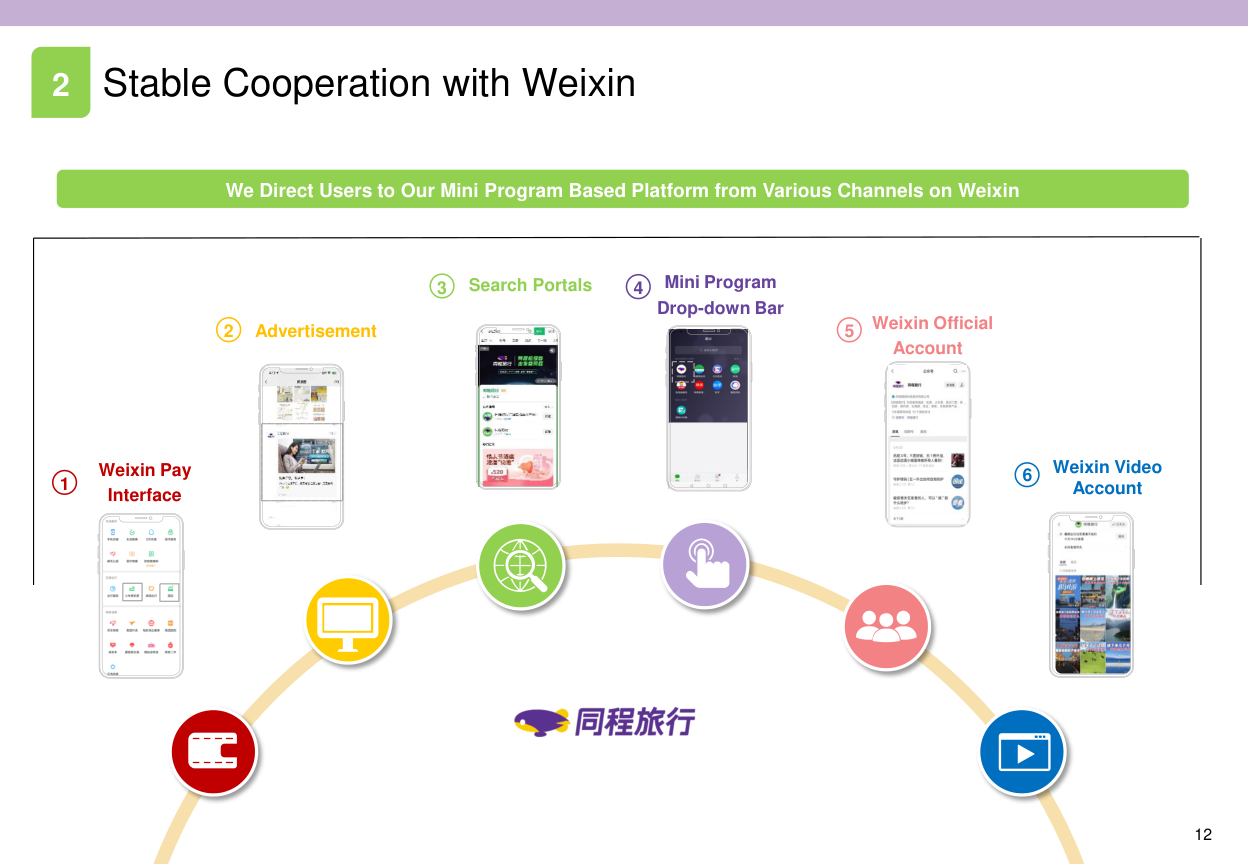
The Weixin point is real, but "default mini app" is too broad The strongest version of the Weixin observation is specific. Tongcheng's May 2026 investor presentation describes the company as the sole operator of the "Rail & Flight" and "Hotel" portals on the mobile payment interfaces of Weixin and Mobile QQ. It also shows routes into its mini-program platform through the payment interface, advertising, search, the mini-program drop-down bar, official accounts and video accounts. In other words, the user need not begin by typing Ly.com into a browser. [4]
Calling Tongcheng "the default WeChat mini app" loses that precision. Weixin contains many mini programs and services. The company's evidence concerns named travel portals and traffic channels, not ownership of the entire mini-program ecosystem. The accurate shorthand is that Tongcheng operates prominent, integrated travel-booking entrances within Weixin's payment ecosystem. The presentation is the company's account of its arrangements, and the accompanying screenshot is a dated depiction, not a promise that every user's current interface looks identical. [4]
This distribution changes what familiarity means. A service repeatedly encountered inside an everyday application can become ordinary without its standalone English-language domain becoming famous abroad. The mechanism is visible in the company's own diagram: several entrances converge on the same travel platform. The inference is about how a brand can become familiar, not proof that integration removes commercial risk. Tencent's distribution is not a guarantee of every booking sold through it.
There is newer confirmation that Weixin remains important. Tongcheng's 2026 interim report describes the Weixin ecosystem as an important source of traffic while also calling its standalone app a key tool for acquiring users. Independent trade publication ChinaTravelNews reported on the Tencent relationship in March 2025. Together, these sources support a picture of multiple channels rather than a business that exists only as a mini program. They do not establish how every booking is split among those channels today. [3][5]
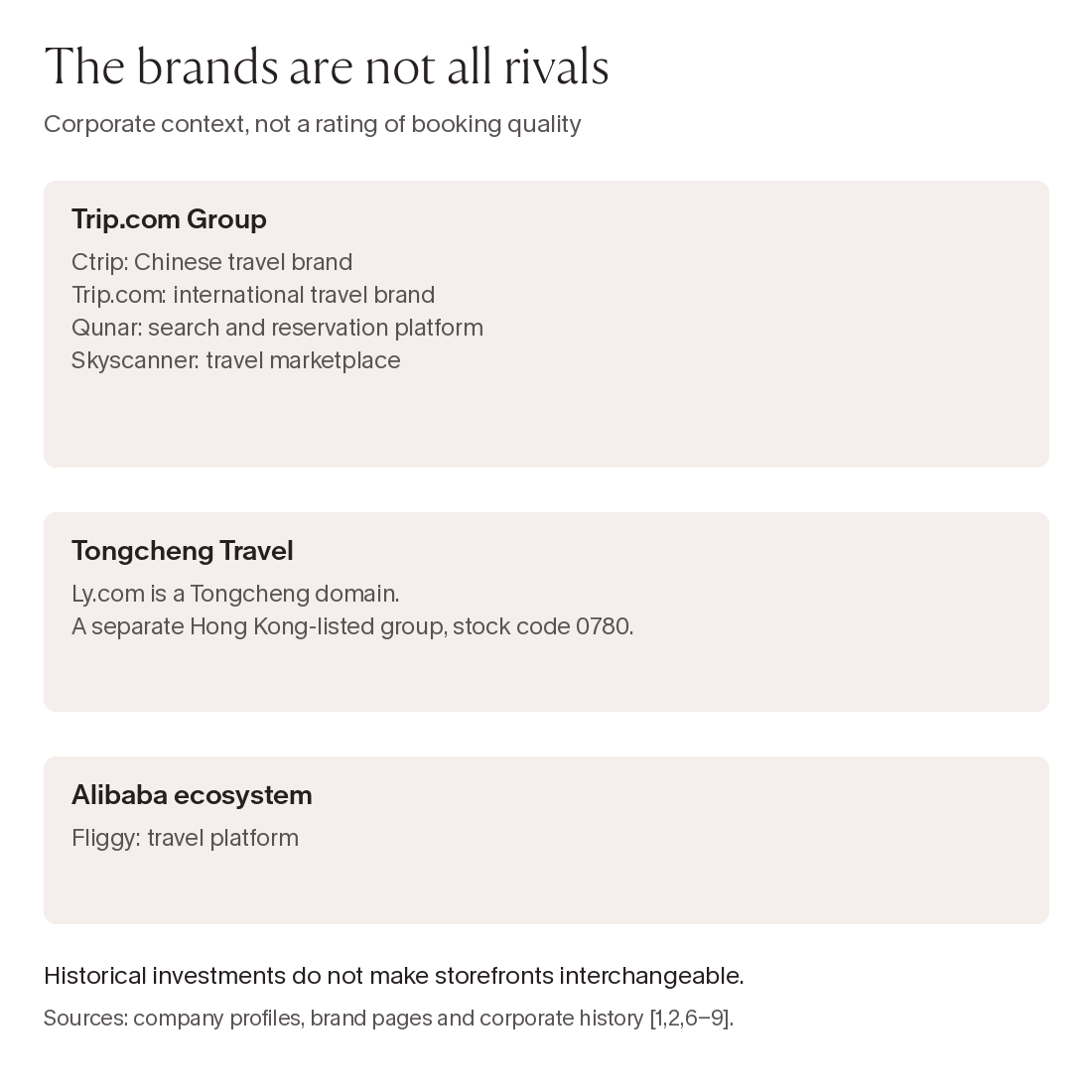
Trip.com, Ctrip, Qunar and Skyscanner belong on the same map Trip.com Group's own brand page lists Trip.com, Ctrip, Qunar and Skyscanner. Its corporate profile likewise describes that portfolio. This is the most important correction to a list that treats all four names as unrelated competitors. The group is one corporate umbrella; the brands are distinct interfaces and products. Recognizing the umbrella helps explain the market without pretending that all four offer the same service. [6][7]
Ctrip, 携程, is the long-established Chinese brand. The group says it was founded in 1999 and offers hotel and air reservations, tours, business-travel services and travel content. Trip.com is presented as an international one-stop travel provider. A person familiar with Ctrip in China may therefore have more context for Trip.com than an American reader encountering the international brand for the first time. That is a difference in brand exposure, not an objective ranking of how carefully either person books. [6]
Qunar, 去哪儿, is also listed in the group portfolio. The brand page describes search and reservation coverage across travel products. Skyscanner is described as a travel marketplace working with travel partners. The practical distinction is between a group relationship and the seller of a specific offer: recognizing a search brand does not by itself identify the business that will take payment or service the resulting ticket. The relevant identity is the one shown in that offer's checkout and terms. [6][7]
The group's history also records investments in Tongcheng Tourism and Elong during 2014-15. That connection should not be flattened into "Ly.com is just another Trip.com website." Tongcheng has its own listed-company identity. A historical investment relationship and a wholly interchangeable consumer storefront are different claims. The clearest map keeps Tongcheng separate while acknowledging the documented connections, rather than turning every financial tie into a simple parent-subsidiary label. [2][8]
Fliggy belongs in the explanation, not in the same corporate box Fliggy, 飞猪, is another name worth recognizing. Alibaba's own business page describes it as an online travel platform providing comprehensive travel services. It belongs in a discussion of China's travel ecosystem because the question is broader than which English-language websites American travelers know. It should not, however, be placed under Trip.com Group merely because both sell travel. Corporate identity is part of the explanation, not a detail to gloss over. [9]
This is also where restraint improves the comparison. A list of Trip.com, Ctrip, Qunar, Skyscanner, Tongcheng/Ly.com and Fliggy explains several major names and their relationships. It does not certify every seller appearing in a metasearch result. Nor does it establish that other unfamiliar international agencies have the same domestic integration as Tongcheng. Extending the argument to a new name requires checking that business on its own evidence.
A large platform can still have serious problems Mainstream status and good conduct are not synonyms. China's market regulator announced on July 25, 2026 that it had confiscated RMB1.658 billion and fined RMB3.521 billion, a combined RMB5.179 billion, over Trip.com Group's abuse of a dominant position in domestic online hotel booking. The decision described exclusive arrangements and cross-platform lowest-price requirements imposed on hotels. Reuters reported that the group accepted the decision and committed to rectification. This is a concrete reason not to convert size into an unqualified endorsement. [10][15]
That enforcement case is not evidence that every Trip.com flight booking is invalid. It concerns a particular market and conduct. The useful lesson runs in both directions: unfamiliarity is not proof of fraud, and familiarity is not proof of fair dealing. An explanation that only celebrates domestic scale misses the second half. A careful reader can recognize a major platform while still examining the conditions of the transaction in front of them.
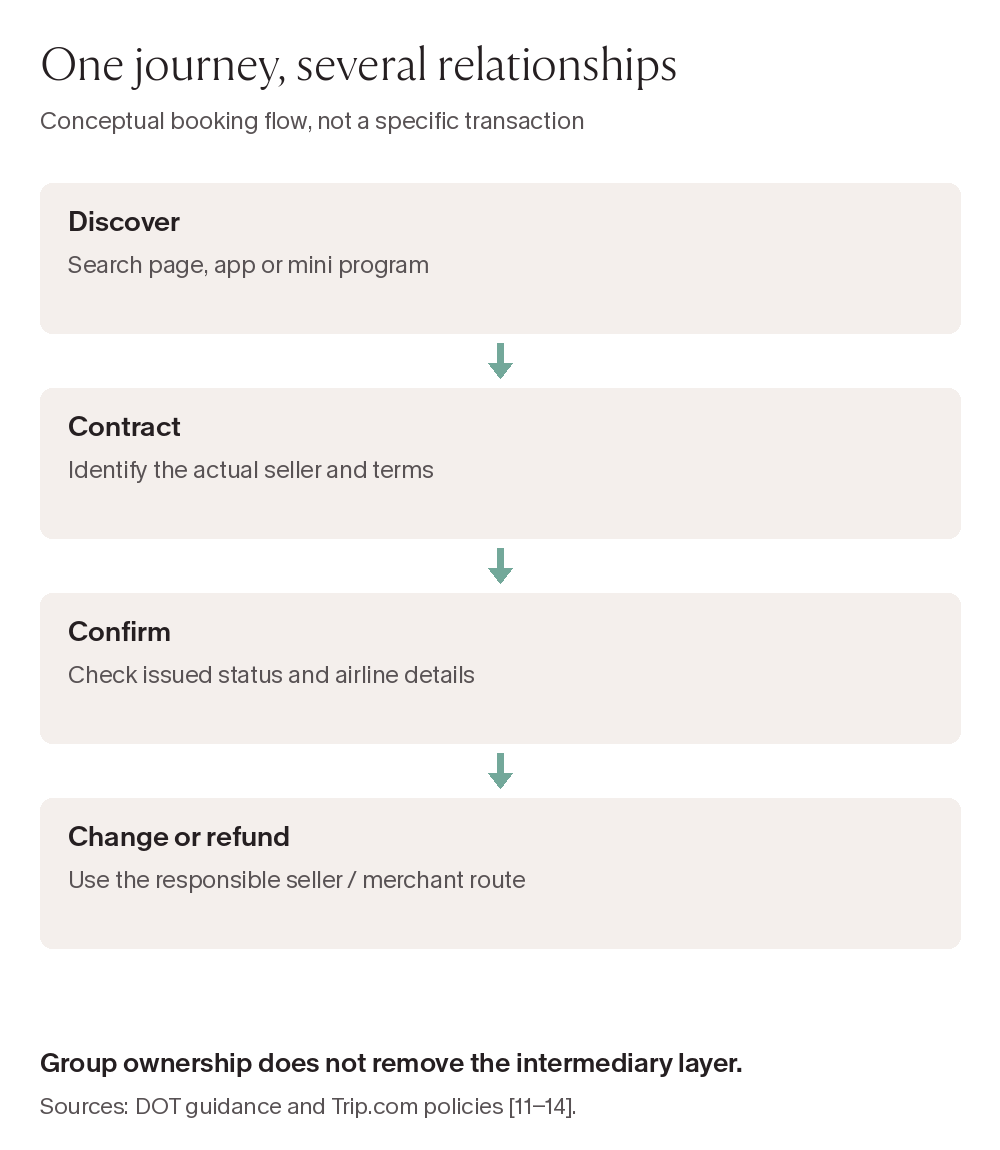
Same group, different storefront, different transaction Corporate maps are useful precisely because they stop short of claiming too much. A traveler can use Trip.com Group's portfolio to recognize the relationship among Trip.com, Ctrip, Qunar and Skyscanner. They cannot infer from that map that every displayed fare has the same seller, currency, support channel or cancellation conditions. The brand page supplies the corporate context. The purchase page supplies the terms of that transaction. Those are complementary records, not substitutes. [6][7][11]
This distinction is particularly important when a search result sends the traveler elsewhere. The familiar name at the start of a search can be a discovery service, while another business becomes the merchant taking payment. Conversely, an unfamiliar-looking domain may be the direct storefront of a large group. The right question is therefore not merely "Have I heard of this logo?" It is "Which company am I contracting with on this offer?" DOT's agency guidance makes that intermediary relationship explicit. [11][14]
Language is another reason not to collapse interfaces together. Trip.com Group's profile says it serves non-Chinese customers mainly through Trip.com and Skyscanner, while describing Ctrip and Qunar as its other one-stop travel channels. This establishes differentiated positioning. It does not establish that a Chinese-language account, a foreign-language booking or a regional promotion can be transferred freely between brands. A traveler should not assume shared corporate ownership creates interchangeable accounts or remedies. [7]
What the low price does not tell the traveler The existence of a cheaper price does not identify its cause. Without comparing an actual itinerary, fare conditions, baggage, currency, payment charges and seller terms, it would be speculation to attribute a price difference to a subsidy, negotiated inventory or a hidden defect. The defensible point is simpler: the same flight number is not a complete product comparison. The purchase includes restrictions and an after-sales relationship, not merely a seat on an aircraft.
The U.S. Department of Transportation describes an agency purchase as allowing an intermediary to find and book travel rather than buying directly from the airline. It advises travelers with ticket problems to contact the agency first and notes that the airline may be limited in the assistance it can provide. That is a structural trade-off, not a judgment unique to Chinese platforms. It explains why a legitimate agency booking can still create an extra layer when plans change. [11]
Trip.com's own materials distinguish a booking from ticket issuance. Its guidance shows customers how to check "ticket issued" status, and its customer-service guarantee contains conditions for remedies. Those are more useful things to inspect than a slogan about reliability. A traveler should establish the issued-ticket status and keep the airline reference, passenger details and conditions. A payment receipt alone should not be made to carry every assurance about the itinerary. [12][13]
The same caution applies to support promises. A published guarantee is evidence of the company's stated policy, not a measured result for a particular claim. Trip.com's hotel guarantee, for example, contains contact requirements, exclusions and limits on compensation. That is why the exact booking terms matter more than an abstract verdict that the whole platform is either "safe" or "unsafe." A cancellation request and an entitlement to a refund are also different things. [13]
The U.S. 24-hour rule is not a universal OTA escape hatch One especially consequential misunderstanding concerns the familiar 24-hour cancellation rule. DOT's consumer guidance says the airline requirement does not apply to tickets booked through online travel agencies, travel agents or other third parties, though agencies may voluntarily provide similar procedures. The airline rule itself also has conditions, including purchase at least seven days before departure. A traveler should read the seller's actual cancellation offer instead of assuming that a U.S.-bound itinerary automatically carries the same agency refund option. [11][14]
DOT also explains that the merchant of record matters when an airline cancels or significantly changes a flight to, from or within the United States. Its guidance assigns refund responsibilities to the relevant merchant of record and distinguishes airfare from ancillary-service refunds. This is U.S. consumer guidance, not a universal description of Chinese domestic law or every international itinerary. The seller, route, reason for cancellation and applicable terms remain material. [14]
When the intermediary matters most The consequences of a booking choice become clearer in a disruption. Before purchase, the comparison is mostly about the displayed offer. After a schedule change, the question becomes who can alter the ticket, who holds the money and which conditions apply. DOT warns that an airline's ability to help with an agency-issued ticket may be limited. That is why a small saving cannot be assessed independently of the traveler's tolerance for an extra service layer. It is an analytical trade-off, not evidence that direct booking is always cheaper or that an agency will always respond badly. [11]
For hotels, the same logic has a different form. Trip.com's published room guarantee asks the customer to contact it when a confirmed booking cannot be honored and contains specified remedies and exclusions. The document does not promise an unlimited replacement hotel at any price. Reading a policy at the moment of purchase is more informative than remembering a general reputation, because the operational route and limits are part of the product. This article is not a review of a tested claim. [13]
A better vocabulary than "sketchy" or "trusted" A useful assessment has layers. First identify the company and genuine domain. Then distinguish group affiliation from the actual seller. Establish whether payment led to an issued ticket, compare the complete conditions and understand the route for changes or refunds. Finally, decide whether the saving compensates for the extra intermediary. These are decision criteria, not a promise that any one distribution channel wins for every traveler.
The original paradox is therefore real but limited. Ly.com can be unfamiliar to an American traveler while Tongcheng is deeply integrated into China's travel-booking channels. Trip.com can be an international brand whose domestic corporate context becomes clearer through Ctrip, Qunar and the wider group. Fliggy can be another major ecosystem-linked name without belonging to that group. The lesson is not to stop being skeptical. It is to direct skepticism at the right object: the specific seller and contract, rather than the unfamiliarity of a name alone.
Sources and further reading
- Ly.com mobile corporate introduction (older, identity only)Ly.com
- Tongcheng corporate profileTongcheng Travel Holdings
- Tongcheng 2026 interim report (six months ended June 30)HKEX · September 2026
- Tongcheng May 2026 investor presentation, pp. 12 and 27Tongcheng Travel Holdings · May 2026
- ChinaTravelNews: Tencent collaborationChinaTravelNews · 24 March 2025
- Trip.com Group: brandsTrip.com Group
- Trip.com Group: corporate profileTrip.com Group
- Trip.com Group: corporate historyTrip.com Group
- Alibaba: Fliggy business profileAlibaba Group
- Reuters: China hotel-booking competition enforcementReuters · 25 July 2026
- U.S. DOT: buying a ticketU.S. Department of Transportation
- Trip.com: checking ticket-issued statusTrip.com
- Trip.com: customer-service guarantee and conditionsTrip.com
- U.S. DOT: refundsU.S. Department of Transportation
- China SAMR: Trip.com competition decisionSAMR · 25 July 2026