The November 2026 AI repricing: twelve days that tested the trade
First published
Updated
Nov 12–24 · Nvidia, Anthropic, the Fed and private credit
Twelve days in November 2026 turned the AI debate into a live stress test: a CEO resignation, record earnings, the largest IPO on record, an SEC investigation, and a reinstatement that added back nearly $1 trillion of market value in a day. Nvidia doubled its revenue and lost almost a quarter of its value in the same stretch. The episode is best read as a crisis of financial confidence, not a crisis of technological progress, and all of its claims can be checked against the record below.
The timeline
What actually happened, November 12 to 24
On November 12, Jensen Huang resigned from Nvidia, introducing leadership, governance and strategic uncertainty at the company most closely associated with the AI infrastructure boom. On November 13, the Federal Reserve's Financial Stability Report flagged the increasing use of corporate debt, private credit, structured financing and project finance to fund advanced computing infrastructure. On November 17, Nvidia reported quarterly revenue of $115.8 billion, up 103% year over year, with data-center revenue of $107.6 billion; the results failed to restore sustained confidence in AI stocks. On November 19, Anthropic went public in the largest IPO on record, attracting considerable demand without reversing the broader selloff. On November 20, the selloff accelerated: Nvidia dropped 14% in one day after Reuters reported that the SEC's investigation into the company includes accounting issues, and the Nasdaq finished the week down roughly 10%, with the Dow and S&P 500 entering correction territory. An investigation is not proof of accounting misconduct. On November 23, Nvidia's board reinstated Huang as CEO; Nvidia surged about 31%, recovering nearly $1 trillion of market value, and the Nasdaq Composite closed 6.5% higher. On November 24, the relief rally began reversing: Nvidia fell again during trading, and Reuters reported Anthropic traded below its $83 IPO price.
- Nvidia revenue growth
- +103% year over year (Q3 FY2027, reported November 17)
- Nvidia stock, week ending Nov 20
- −23% approximately
- Nasdaq, same week
- −10% approximately
- Nvidia, November 23 alone
- +31% after Huang's reinstatement
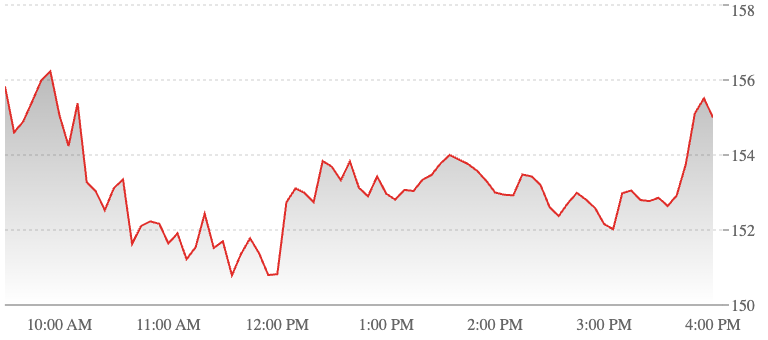
- Nvidia, November 24 snapshot captured 4:16 PM EST, after the regular session
- $155.38, down 5.78% on the day; after-hours $153.91; market cap about $3.77 trillion; trailing P/E about 19.5
The snapshot was captured at 4:16 PM EST, after the regular session: it displays $155.38 (down 5.78% on the day) with $153.91 quoted after-hours. It is a displayed quote, not an independently verified official close. The pattern is the point: one of the fastest-growing businesses in history can still produce violent short-term investment performance. That is why practitioners distinguish between business, economics and investing.
Interactive: twelve days in eight events
Step through the sequence, or jump to a date.
The arithmetic
How a company can double revenue while its stock crashes
Nvidia's November 17 report contained two different signals at once. Quarterly revenue reached $115.8 billion, up 103% year over year, with data-center revenue up 110%. Quarterly net income was $65.3 billion, and current GAAP gross margin was 74.8%, exceptional pricing power by any standard. Yet next-quarter gross margin guidance implied compression to 71–72%, and the company's roughly $130 billion revenue guidance implies growth decelerating from triple digits. The company also disclosed that its new Vera Rubin platform generated nearly $20 billion in its first quarter of production shipments, the fastest product ramp in its history.
Nvidia is not a speculative startup with no revenue. It is an extremely profitable company. But investors are not buying its historical earnings; they are buying future earnings relative to the price paid today. When expectations fall, a growing business can become a losing investment through multiple compression: the business can grow earnings 30% while its stock declines, because investors are no longer willing to pay the same premium for each dollar of earnings. The interactive below makes the arithmetic concrete.
Different disciplines answer different questions about the same company. A business operator sees record sales and successful product launches. An economist sees rising demand, supply constraints and competition. A venture capitalist sees evidence of an expanding ecosystem. A growth-equity investor asks whether growth translates into sustainable cash flow. A public-equity investor asks whether expectations justify the valuation. A hedge fund asks whether expectations are mispriced. A private-credit lender asks whether Nvidia's customers can repay the debt used to purchase its products. Nobody necessarily disagrees about the technology.
Interactive: how a growing business becomes a losing investment
Start with $10 of earnings per share and a $500 share price (a 50× P/E). Move earnings growth and the multiple investors are willing to pay.
New earnings per share
$13.00
New share price
$390.00
Investor's price return
−22.0%
Illustrative valuation model, not an Nvidia price forecast. Excludes dividends. This is multiple compression: earnings up 30%, stock down 22%, when the multiple falls from 50× to 30×.
The chain
The compute thesis meets its financiers
Silicon Valley's thesis is that intelligence becomes a fundamental input into economic activity, like electricity or labor: the more capable AI becomes, the more tasks get delegated to it, and the more compute the economy consumes. Nvidia's results support the existence of substantial demand. But Wall Street is asking a deeper question: where does the money ultimately come from?
The AI value chain runs from capital markets (equity, debt, private credit) to clouds and data centers, to AI model developers, to AI applications and agents, and finally to paying end customers. Chipmakers such as Nvidia and AMD sell into the middle of that chain. Everyone upstream is spending money based on expectations about everyone downstream: Nvidia expects data centers to keep buying chips, data centers expect AI labs to keep renting compute, AI labs expect enterprises to keep purchasing AI services, and enterprises expect those services to produce measurable benefits. If the final step fails to materialize sufficiently, the economic assumptions throughout the chain can break. That is the central bear thesis: not that people will stop using AI, but that monetizable demand might not grow fast enough to support the infrastructure already being financed.
The credit layer
Private credit, circular financing and the Fed's first close look
On November 16, Federal Reserve Governor Michael Barr gave a speech in Milan drawing on the Fed's November Financial Stability Report, the first time the report has devoted a section to how the AI buildout is financed. The figures he discussed: on-balance-sheet debt of the seven largest AI firms is expected to exceed $800 billion before year-end; the estimated maximum nominal value of off-balance-sheet obligations, including leases not yet started, take-or-pay contracts and residual-value guarantees, now exceeds $3 trillion; and hyperscalers and major GPU producers hold over $100 billion of cumulative equity investments in AI model developers and cloud startups. The Fed notes the off-balance-sheet figures are undiscounted and not directly comparable with debt, and the categories should not simply be added together.
The most interesting concept is circular financing. A chipmaker invests in an AI startup; the startup uses that money to purchase cloud compute; the cloud provider uses its revenue or anticipated demand to purchase more chips from the original chipmaker. All three companies can report legitimate economic activity; strategically funding customers can help establish new markets, and this is not inherently fraudulent. The key question is whether the startup can eventually replace investment capital with revenue from independent paying customers. Otherwise the ecosystem depends on continued access to financing. Reuters reported on November 20 that the SEC's investigation into Nvidia includes accounting issues; separately, investors have raised concerns about interconnected AI financing arrangements. The scope and outcome of the investigation remain unresolved.
Interest rates compound the problem. On November 18, the Fed released minutes indicating that almost all policymakers anticipated further interest-rate increases would likely be appropriate under their baseline outlooks. Higher rates hit twice: growth companies are worth less today because distant profits are discounted more heavily, and infrastructure becomes more expensive to finance, particularly for borrowers reliant on floating-rate debt or refinancing. A hypothetical $10 billion data-center project carrying $7 billion of floating-rate debt against $1 billion of annual operating cash flow before interest illustrates the sensitivity; the interactive below lets you move the borrowing rate. Higher financial yield is attractive to a lender only if the borrower can actually make the payments. This is why AI infrastructure risk is no longer confined to technology stocks: it matters to private credit funds, banks, insurers, utilities and infrastructure managers.
Interactive: data-center financing sensitivity
A hypothetical $10 billion project with $7 billion of floating-rate debt and $1 billion of annual operating cash flow before interest. Move the borrowing rate.
■ Interest expense ■ Cash remaining
Annual interest expense
$630M
Cash flow after interest
$370M
Before principal repayments, taxes and replacement capex. Above a ~14.3% rate, interest alone consumes the entire cash flow.
The chips
Intel, AMD and Nvidia: three different bets on the same revolution
Nvidia's advantage extends beyond chips to CUDA, networking, software libraries, developer adoption and integrated systems; its challenge is maintaining exceptional pricing power as competitors emerge and customers develop their own silicon. AMD primarily designs chips and outsources manufacturing: on November 3 it reported $13.4 billion of quarterly revenue, up 45%, with data-center revenue growing 97% year over year, and it stands to benefit from customers seeking alternatives to Nvidia. Intel faces the additional challenge of operating advanced semiconductor factories: its October 29 earnings triggered a sharp selloff, with shares falling roughly a fifth, after warnings about manufacturing bottlenecks, cash burn and substantial capital spending.
Semiconductor manufacturing yield is where engineering becomes a financial issue. If Intel spends billions building a fabrication facility but struggles to manufacture enough functional chips economically, it has a capital-allocation problem regardless of how large AI chip demand is. AMD avoids much of that direct manufacturing risk by outsourcing, though it inherits supply-chain dependencies; Nvidia does the same while currently enjoying substantially stronger margins. This creates a policy conflict: the United States wants domestic semiconductor manufacturing capacity for national-security reasons, but shareholders want returns on invested capital. Something can be strategically valuable to a country without being an attractive investment for private shareholders.
The counterforces
Open weights, on-prem AI and agents cut demand both ways
Two competing technological forces are acting on compute demand. Pushing consumption up: reasoning models, autonomous agents, AI teammates, video generation, robotics and continuous AI workflows. Pushing compute per task down: smaller specialized models, quantization, model distillation, efficient chip architectures, local inference and intelligent model routing. The unresolved question is whether growth in usage outweighs improvements in efficiency. Silicon Valley is betting that it will; Wall Street is waiting for evidence.
The agentic paradox makes this concrete. A company with 100 employees prompting AI 20 times a day generates 2,000 daily requests. Give it 100 embedded agents working continuously at 200 model calls a day and it generates 20,000. Even if every call becomes five times cheaper, total spending could double. That is the Jevons paradox applied to inference, and increased consumption still does not guarantee higher margins for the compute provider.
This also explains why Nvidia's interests differ from a model developer's. Cheaper, better open-weight models pressure proprietary model pricing, but Nvidia sells hardware to companies running either kind of model. In September, Nvidia announced its proposed acquisition of Hugging Face, the major open-model ecosystem and developer platform, and its November earnings highlighted local AI hardware and support for open models and agents. Nvidia is hedging across deployment futures: frontier proprietary models, open weights, on-prem enterprise AI, edge AI, and agent-driven continuous inference all require hardware. It does not need one particular model to win; it needs a large enough share of economically sustainable computing demand.
The IPO
Anthropic's debut moved the debate to the public market
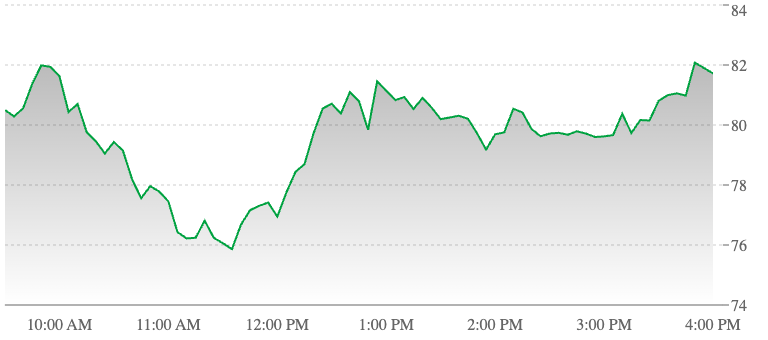
Anthropic priced its IPO at $83 per share on November 18 and began trading on Nasdaq on November 19, opening at $111.50 and closing its first day at $97.17, up 17%, in the largest initial public offering on record. By November 24, Reuters reported, the shares had traded below their IPO price, with the company's valuation during that day's trading still around $1.5 trillion, roughly 40 times trailing annual sales.
The difference between Anthropic and Nvidia matters. Nvidia sells much of the infrastructure; Anthropic must purchase enormous quantities of computing capacity and then monetize the intelligence it produces. Its IPO prospectus explicitly acknowledges the capital-intensive nature of frontier AI and its dependence on generating substantial revenue to fund ongoing compute needs. The bullish thesis is that frontier intelligence becomes one of the most valuable services in the global economy. The bearish thesis is that intelligence commoditizes, customers gain bargaining power, and the cost of staying at the frontier prevents model developers from capturing enough profit. Neither thesis requires AI to fail technologically. The IPO transferred part of that debate from private venture investors to a public market that reprices its expectations every day.
Key-person risk
What Huang's departure and return actually revealed
The extraordinary part of the past two weeks is not simply that Nvidia's CEO resigned and returned. It is that one company's leadership became important enough to move global equity markets and draw in the government. President Trump supported Huang's reinstatement, according to Reuters; Nvidia's board said it received input from senior government officials and established an independent committee overseeing national-security and export-control compliance, while other officials continue to question the company's compliance and disclosures.
There are four readings of the episode. Silicon Valley's: restoring a visionary leader protects innovation and momentum. Wall Street's: removing leadership uncertainty reduces one source of investment risk. Washington's: Nvidia is strategically important to American technological competitiveness. The governance reading: dependence on one executive and political intervention raise questions about board independence and succession.
From a behavioral-finance perspective, Huang also personifies the narrative underpinning much of the AI trade: technological progress, unlimited compute demand, the future of AI. Did the world's demand for AI intelligence fundamentally increase by nearly a third overnight because he returned? Probably not. Some of the rally reasonably reflects improved expectations about leadership, execution and risk; some likely reflects short covering, relief buying, positioning and sentiment, and public price movements alone cannot separate those effects. The magnitude of the reaction demonstrates both the value of leadership and the danger of key-person risk. A durable company should ultimately be capable of surviving its founder's departure.
Four lenses
How four investment philosophies would read the crash
These are applications of established investment philosophies, not claims that the investors named have personally assessed November's events. A Buffett lens asks about business quality and intrinsic value: does Nvidia have a durable moat, can it maintain exceptional margins, how much cash can shareholders ultimately receive, and is the price reasonable relative to that value? A wonderful business is not automatically a wonderful investment at every price. A Howard Marks lens asks about cycles and risk: what expectations were embedded in AI valuations, are lenders adequately compensated for infrastructure risk, and has the market swung from excessive optimism to excessive pessimism? A crash can create opportunity, but only when the lower price sufficiently compensates for the risk. A Zhang Lei lens asks about structural transformation: which industries will AI permanently reorganize, which companies can create lasting value through that transformation, and where can capital and operational expertise accelerate adoption? A Michael Burry lens interrogates accounting and contrarian risk: are companies overstating the economic lives of their chips, are infrastructure investments earning adequate returns, and do financial statements fully reflect the costs of the buildout? Burry has publicly warned about excessive AI investment and the depreciation assumptions applied to AI hardware. Combining the four is more useful than choosing one: business quality, price and risk, structural change, and accounting skepticism together make a more complete process.
Deal pressure
Where value-destroying M&A enters the story
During a technological boom, corporations face enormous pressure to demonstrate an AI strategy, and management teams respond by buying startups, investing in model developers, signing enormous infrastructure contracts and acquiring competitors. Investment bankers earn fees facilitating many of those transactions, and activity can be confused with value creation. Nvidia's proposed Hugging Face acquisition could be strategically valuable because it strengthens its position in the open-model ecosystem, but the financial question is whether ownership creates enough additional value compared with a partnership. The same applies to a traditional company spending billions acquiring an AI startup when an internal implementation, licensing agreement or commercial partnership might have achieved comparable results. The relevant comparison is not acquisition versus doing nothing; it is acquisition versus the best alternative use of capital. Opportunity cost is one of the most important intersections of economics and investing.
The next risk: if AI valuations and access to capital remain under pressure, companies could begin writing down previous acquisitions, renegotiating contracts, consolidating competitors or selling assets. That would create distressed-investment opportunities even while destroying value for some original shareholders.
The comparison
Dot-com, 2008, or something else
The current situation shares features with both historical episodes without equaling either. The dot-com crash paired excessive valuations with telecom infrastructure overbuilding around a technology that ultimately proved enormous. The 2008 crisis centered on leverage, collateral and systemic credit risk in highly interconnected institutions, not technology. Today's AI boom combines both concerns: valuations and infrastructure financing, spread across equity, corporate debt, private credit and project finance, around a technology whose value is potentially enormous. The Federal Reserve itself has drawn the comparison between the current buildout and the late-1990s telecom investment cycle, and warned that hedge-fund leverage and complex financing relationships could amplify a repricing.
But a stock-market correction does not establish a systemic credit crisis. That would require much stronger evidence of widespread defaults, refinancing failures, collateral impairments and transmission into financial institutions. The most defensible reading today: a dot-com-style valuation and capital-allocation debate with an increasingly significant credit component.
The traps
Behavioral finance for a market like this one
This market is an ideal exercise in separating useful contrarian intuition from harmful bias. Narrative bias says Jensen Huang represents the future, so Nvidia must be a good investment; the counter is separating leadership quality from valuation. Recency bias says stocks crashed, so AI is failing; the counter is examining multi-year demand and earnings. Confirmation bias collects only the news supporting an existing bull or bear thesis; the counter is actively seeking opposing evidence. Authority bias treats a famous investor's claim as decisive; the counter is examining assumptions and incentives. Anchoring says Nvidia used to trade much higher so it must be cheap now; the counter is recalculating value independently. Herd behavior says everyone is investing in AI; the counter is understanding what is already priced in. Hindsight bias says the crash was obviously inevitable; the counter is documenting predictions before outcomes.
The most useful application of AI to an investment process is not asking whether a company is a good investment. It is asking for the strongest bull case and the strongest bear case, identifying where they rely on different assumptions, and then determining what observable evidence would falsify each. A genuine edge should be testable against reality; otherwise it is difficult to distinguish insight from a persuasive personal narrative.
Scenarios
Four directions from here
Map the next phase on two axes: AI adoption growth and supplier profitability. High adoption with strong commercial returns is a sustainable boom. Slow adoption with strong pricing and disciplined spending is niche profitability. Weak adoption with overcapacity is an infrastructure bust. And high adoption with weak supplier economics is AI commoditization: the technology transforms society while suppliers struggle to capture the value.
The fourth scenario is a particularly compelling framework for the current moment: AI becomes ubiquitous, creates extraordinary productivity gains, and increasing competition transfers a substantial share of the benefits to enterprise customers rather than infrastructure and model providers. In that world, Silicon Valley was right about the technology and skeptical Wall Street investors were right about portions of the investment economics. Different segments of the industry could experience different outcomes simultaneously.
Interactive: the four directions, mapped
Two axes: how fast AI adoption grows, and whether suppliers earn attractive economics. Click a quadrant.
Conceptual scenarios; different segments of the industry could land in different quadrants at once.
The dashboard
What to monitor from here
The indicators that will distinguish the scenarios: Nvidia margins (new products sustaining pricing power versus sustained deterioration); GPU rental prices (high utilization at attractive prices versus falling prices and excess capacity); hyperscaler cash flow (AI revenue catching up with capex versus persistent deterioration); private credit (stable repayment and refinancing versus defaults and widening spreads); enterprise agents (paid production adoption with measurable ROI versus pilots that fail to convert); open-weight models (new profitable deployments versus severe pricing pressure without volume); data centers (on-time energization with contracted tenants versus cancellations and stranded capacity); monetary policy (improving financing conditions versus higher rates and tighter liquidity); and corporate governance (transparent disclosures and effective controls versus material adverse regulatory or accounting findings).
As of November 24 the market remains volatile, the Nvidia investigation is unresolved, and the longer-term economic returns on AI infrastructure have not been established. Interpretations of where value migrates are investment judgments, not settled facts.
The thesis
Three bubbles people keep confusing
It helps to distinguish three separate claims that get blurred together. An intelligence bubble: AI capabilities are fundamentally overhyped and will not deliver transformative value. An infrastructure bubble: AI is genuinely transformative, but too much infrastructure is being built too quickly at excessive cost. A valuation bubble: excellent AI companies exist, but investors are paying prices that assume implausibly favorable outcomes. One can believe strongly in AI while believing the second and third bubbles exist in parts of the market.
The important question is no longer simply whether AI will change the world. It is who pays for that transformation, who captures the economic surplus, and whether the investors financing it earn sufficient returns. That question connects Huang, Nvidia, Intel, AMD, Anthropic, private credit, data centers, open-weight models, embedded agents, and the entire Wall Street versus Silicon Valley debate.