Hangzhou industry in 2026: a platform city with a factory floor
First published
Updated
2025 statistics baseline · 10-module field guide
Hangzhou is often described as one giant AI park. The statistics describe something more specific: a services-heavy platform economy with a substantial industrial base. This note separates reported baselines from policy targets, then reproduces the complete field guide with its district map, diligence questions and per-module sources.
A dated policy document
Hangzhou's economic and information authorities published an AI industry-chain action plan on February 27, 2025. The plan covers 2024-2026 and states that it is effective from February 2, 2025 through December 31, 2026. The scope and validity dates are part of the policy story. [1]
The official page identifies the document as an action plan for high-quality development of the full AI industry chain. That framing is broader than an announcement about one company or a single software product. It includes infrastructure, models, data and applications. [1]
The plan sets goals for 2026, including at least one general foundation model, more than 20 industry-specific models, 10 AI-focused industrial parks and more than 1,000 enterprises in an open-model ecosystem. These are stated ambitions, not verified achievements. [1]
No progress audit was examined for this note. The presence of a target in an official document does not establish that the city has already reached it. A headline reporting completion would require later evidence with dates and definitions.
Infrastructure under the software story
At the foundational level, the plan discusses AI inference and training chips. It also names specialized chips for areas such as autonomous driving and drug discovery. This makes hardware part of the city's stated AI strategy, rather than treating AI solely as consumer applications. [1]
The document addresses storage devices, including server-related and newer memory technologies. Its infrastructure discussion connects computation with storage needs. Naming a technology in the plan does not prove that local manufacturers have achieved commercial scale in that technology. [1]
Networks receive a separate role, with attention to switches, routers, optical networks and gateways. The policy frames these as part of the infrastructure supporting AI. It does not provide a verified performance benchmark for a deployed citywide system. [1]
AI servers, heterogeneous computing and liquid-cooled equipment also appear in the plan. These are specific development directions, not a complete inventory of currently installed capacity. The distinction matters when translating policy language into an article about the economy. [1]
Models depend on data and software
The technical layer includes algorithms, software frameworks and models. The plan discusses areas such as computer vision, natural-language processing and multimodal work. It calls for supporting tools as well as the models themselves. [1]
For general models, it emphasizes datasets, algorithm and operator libraries, development environments and access through model services. These are proposed ecosystem supports. The document does not independently evaluate the quality of any particular model a reader might use. [1]
For industry models, it discusses customization based on sector knowledge and shared application platforms. The policy links model development with businesses that might use them. A plan for sector models is not evidence of measured improvement in every participating industry. [1]
Data supply includes collection, cleaning, desensitization and governance, alongside graded access to public resources. The document repeatedly frames access within compliance. It should not be summarized as unrestricted release of government or private datasets. [1]
Applications and public services
Scientific applications include drug development and new materials. The plan proposes dedicated AI research platforms. That is a direction for research infrastructure, not a claim that a specific drug or material has been successfully developed because of the policy. [1]
For the real economy, the plan names manufacturing transformation and scenarios including supply chains, finance and energy. These examples show the breadth of intended application. They do not provide before-and-after evidence of economic benefits. [1]
Medical, transport, cultural and other social applications appear as well. Each would require its own safety, performance and operational assessment. Inclusion in an industrial plan does not replace those assessments or confer clinical approval. [1]
Government services and urban management form another group of scenarios. The document discusses government models and traffic-related systems, among other uses. This note reports these as policy intentions and avoids portraying every proposed application as a functioning public service. [1]
Ecosystem and execution
The plan proposes talent support, education links and cross-disciplinary work involving universities and companies. It also discusses attracting projects and open-source participants. These are execution tools alongside the numerical targets, not proof of later recruitment results. [1]
Industrial parks and statistical monitoring receive attention in the ecosystem section. The plan's call to build a monitoring system is especially relevant: measuring an industry requires definitions and updated enterprise lists, not merely counting recognizable companies. [1]
Fiscal and financial support are discussed across research, computing, models, applications and public services. The document is not a price quote, an approved grant or a promise that any business qualifies. Current eligibility would need the actual implementing program and its rules. [1]
The plan ends with organizational, policy and communication measures. Its full structure shows an attempt to coordinate an industry chain. This note's conclusion remains limited: Hangzhou set out an ambitious policy framework; whether and how it delivered is a separate reporting assignment.
The complete field guide
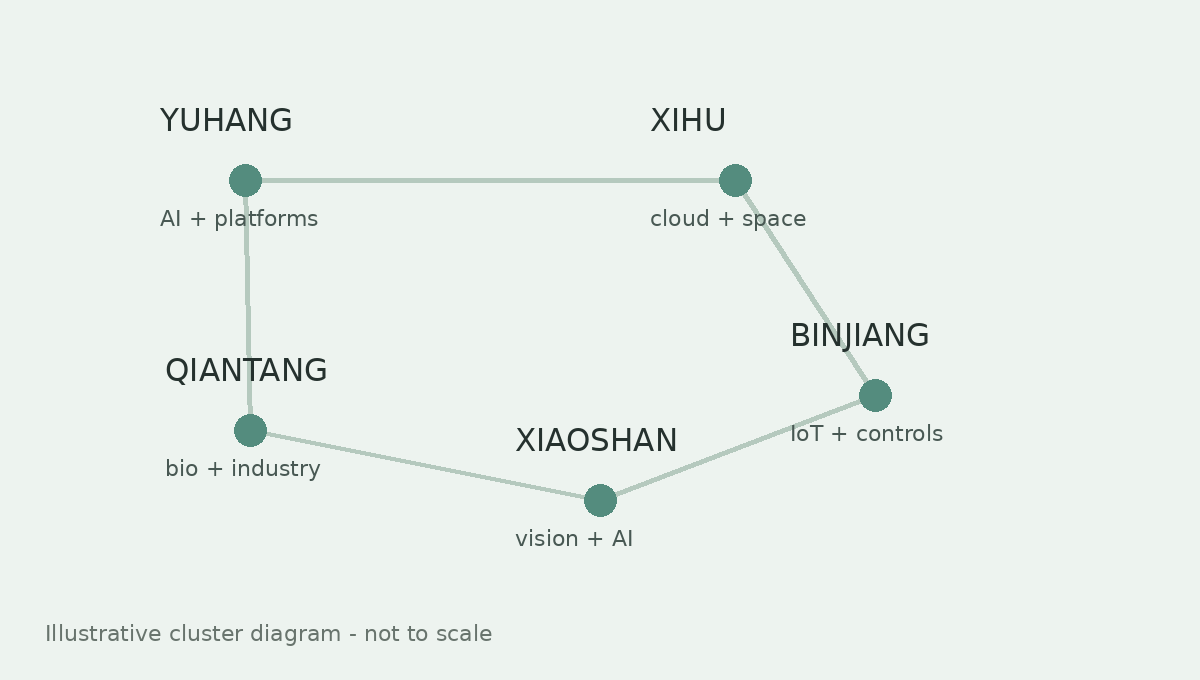
Hangzhou is a platform-and-product city with a real manufacturing base, not one giant AI park. Strong opportunities join software, distribution, design, hardware integration and regulatory execution. Ask what is actually built, sold and delivered at each site: a famous neighbor is not a customer.
01 / Read the economic structure
The latest complete city statistical baseline here is 2025, not a projected 2026 total. Hangzhou reported GDP of RMB 2.3011 trillion, up 5.2%. Services made up 73.8% of value added, secondary industry 24.5%, agriculture 1.7%. Digital-economy core industries contributed RMB 678 billion in value added, 29.5% of GDP, up 9.3%. This definition does not encompass every firm that uses software.
Above-designated-size AI core firms reported RMB 460 billion in revenue, up 23.1%. Revenue and value added are different measures and likely overlap. Privately owned firms accounted for RMB 498 billion, or 77.0%, of goods exports. So the investor has to understand both software/platform distribution and the industrial and logistics chain.
Self-check: Can RMB 460bn in AI revenue be added to RMB 678bn in digital value added?
No. Different measures and overlapping sectors.
02 / The six little dragons are a signal, not an index
The commonly cited six are DeepSeek / 深度求索 (foundation models), Unitree / 宇树科技 (quadruped and humanoid robots), Deep Robotics / 云深处科技 (inspection robots), Game Science / 游戏科学 (games and IP), BrainCo / 强脑科技 (brain-computer interfaces), and ManyCore / 群核科技 (3D spatial software). Xinhua names all six in its 2025 account. Alibaba is a larger local anchor but not one of the six.
The lesson is breadth across models, machines, content and tools, plus a pipeline of technical talent and company formation. It is not proof that any tenant near these firms has customers, defensible IP or economic ties to them. Distinguish a supplier, a paid customer, a reseller and a park neighbor.
Self-check: What shows a robotics cluster is more than a showroom?
Paid installations, active testing, supplier lead times, repair data, and unchaperoned customer references.
03 / AI: the full stack and who captures value
Trace chips, server capacity and power → cloud scheduling → foundation models → proprietary data and integration → distribution and paid workflows. Alibaba Cloud and Qwen anchor one ecosystem; DeepSeek is a separate model developer. Hangzhou's 2024-26 AI plan names heterogeneous compute, servers, model development, datasets, open source and application scenarios. It proposes compute vouchers, but an announced program is not guaranteed cheap, available GPU time.
A strong application company should demonstrate data rights, measurable task accuracy, inference cost after support, workflow integration and customer retention. Generic wrappers face rapid imitation and falling model prices. Ask for actual contracted compute price, available chip mix, uptime and whether Chinese health or industrial data may be used or transferred as proposed. Zhejiang University supplies research and robotics talent, but do not assume every startup has access to the university's IP.
Self-check: Name three useful enterprise-AI diligence metrics.
Paid deployments, gross margin after inference and support, measured customer outcome against baseline.
04 / Biotech: Qiantang and the Medical Port
Qiantang / 钱塘, including Hangzhou Medical Port / 杭州医药港 and Heda / 和达 parks, is the main biotech-industrial anchor in local reporting. Qiantang describes itself as housing around half of the city biopharma industry; treat that as a local characterization, not audited market share. A nucleic-acid drug cluster / 核酸药谷 launched there in 2025. Specific tenant lists change, so verify the legal entity and operating address on the day of the visit.
Follow discovery through IND-enabling studies, clinical trials, CMC process development, GMP manufacturing, approvals and market access. A park might create value through analytical equipment, compliant waste treatment, pilot-scale capacity and QA talent. Ask whether each asset is actually qualified, bookable and permitted for the intended activity. For a US-China biotech deal, spell out IP ownership, territorial licenses, milestone payments, data transfer, regulatory responsibility and trial funding.
Self-check: What outranks a count of biotech tenants?
Owned IP, validated process, regulatory record, paid contracts, usable compliant space, and cash runway.
05 / Robotics and hardware: inspect the factory graph
Unitree and Deep Robotics bring attention to Hangzhou robotics. The supply chain behind a working robot includes motors, reducers, encoders, drivers, batteries, controllers, machining, cameras or LiDAR, software and field service. Not all parts are made in Hangzhou. Map suppliers by exact site, second source, lead time, yield, IP ownership and export exposure.
A warehouse demonstration on a tidy floor says little about uptime around workers and forklifts. An inspection robot must prove route coverage, terrain performance, battery swapping, safety certification, maintenance response and integration with work orders. For humanoids, demand a task-level return on investment, not just graceful locomotion. Hypothetical example: a two-robot installation sold for RMB 300,000 with RMB 180,000 hardware cost looks like 40% margin. After RMB 25,000 installation, RMB 35,000 first-year service and RMB 20,000 failure reserve, contribution falls to RMB 40,000 before engineering and sales.
Self-check: What should follow a production-capacity claim?
Ask for booked orders, utilization, line bottlenecks, component availability, accepted-unit yield and warranty history.
06 / E-commerce, livestream, and warehouses
Hangzhou's platform ecosystem extends from merchants and creator/MCN production to ads, payments, customs brokers, bonded warehouses, overseas fulfillment, returns and tax. The city's 2025-27 digital-trade plan supports “livestream + platform + cross-border e-commerce”; its export and cross-border payment figures are future targets, not booked business.
At a warehouse, follow a real SKU through purchase order, inbound scan, customs status, shelf, pick/pack, dispatch, returns and write-off. Ask for volume, error and labor distributions rather than the best hour. Which entity is exporter of record? Where does title pass? Is this bonded, domestic or overseas stock? Who owns buyer data and eats the return?
Self-check: What is better than GMV alone?
Cohort contribution margin after all platform, creator, ad, fulfillment and refund costs.
07 / The district map: where the actual work happens
余杭 / Future Sci-Tech City (未来科技城): Alibaba-adjacent platforms, AI, software, research commercialization and a growing advanced-manufacturing mix. Test whether the target has real customer or technical ties to the anchor.
滨江 / Hangzhou High-Tech Zone: mature software, IoT, video/security, industrial controls and AI. Local reporting profiles SUPCON / 中控 industrial AI; Hikvision, Dahua and Uniview are part of its security-system history. Dense ecosystem, but compare talent and rent cost.
钱塘 / Qiantang and Medical Port: wet labs, pharma manufacturing, process scale-up and industrial land; better fit for regulated production than a downtown software office. Check site-specific environmental permits, utilities and zoning.
西湖 / Yunqi (云栖) and Zijin'gang: cloud/software, AI and commercial-space ambitions. An announced satellite supplier platform is not a flight-qualified factory. University adjacency is relevant to hiring.
萧山 / Turing Town (图灵小镇), China Vision Valley (中国视谷), airport: AI compute and incubators, intelligent vision, manufacturing test beds and logistics links. Turing Town's research centers and compute center are leads to verify, not guarantees of capacity or tenant revenue.
Self-check: How do you compare parks offering equal base rent?
Compare permitted use, fit-out, utilities, staff access, signed incentives, fees, deposits, escalations and cost of exit.
08 / Government capital and incentives
Hangzhou's late-2025 “3+N” policy names three government funds (science and technology, innovation, and M&A) plus state-owned-enterprise funds, aiming for group scale above RMB 500 billion during the 15th Five-Year Plan period. That is a future fund-scale goal, not one cash grant account or committed disbursement to any project. District funds and park-level concessions add another layer.
Separate equity terms (valuation, control, preferences and local-return covenants), reimbursed grants (eligible expense, award, audit and clawback), in-kind resources (space, testing, compute) and customer introductions. A park's verbal rent holiday might depend on local registration, tax contribution, milestones or annual budgets. Compare after-tax, all-in five-year cash flows and the freedom to leave. Get the current rule, award notice, lease and fund documents before underwriting benefits.
Self-check: What turns a subsidy claim into an assumption?
Current rules, written eligibility or award, binding terms, disbursement and audit schedule, clawback conditions.
09 / Talent, rent, and foreign-invested setup
Zhejiang University and associated institutes feed research and engineering talent; the AI plan calls for interdisciplinary AI-plus-manufacturing and AI-plus-medicine training. Probe role-specific scarcity: controls, model engineering, CMC/QA and export compliance are different labor markets. Ask where the last ten technical hires came from and their one-year retention.
A cost anchor, not a live quote: Savills reported Q1 2025 citywide Grade-A office rent of RMB 4.1/m²/day and 26.3% vacancy. At 100 m² and 30 days that is RMB 12,300/month before fees, taxes, fit-out and deposits. It is an old office benchmark, not a 2026 park, laboratory or warehouse tariff. Lab/industrial rent has no honest citywide range without specifications. Seek current comparable quotes with power, floor loading, fire rating, cold chain, cleanroom and wastewater permissions.
For a foreign-invested enterprise (外商投资企业), begin with the current negative list and sector licenses, then select structure and business scope, verify the investor documents, register with the district authority, set up bank, tax and foreign-exchange procedures, obtain site and industry permits, and maintain accounting, employment, data and customs compliance. MOFCOM's 2025 guide gives a baseline; district authorities and local counsel should confirm 2026 rules. US ownership and Chinese residence require separate tax and reporting advice, not a presumption that a WFOE solves everything.
Self-check: Who can confirm eligibility for a foreign-invested operation?
The current official rules and competent authorities, checked with qualified local legal and tax advisers.
10 / Risks and the park-tour playbook
Hangzhou is strong in software/platform commerce and selected robotics and bio. Shanghai may offer deeper global capital and pharma headquarters, Suzhou biomanufacturing, and Shenzhen dense electronics supply chains. One venture may need all four. Local risks include imitation, platform dependence, uneven lab or factory readiness, cross-border data and export controls, subsidy dependence and a property narrative that outruns utilization. The Q1 2025 office-vacancy figure is a reason to inspect lease terms, not proof that all industrial parks are empty.
Before the pitch, count working loading bays and active labs, log each company's Chinese legal name and exact address, and ask for an unchaperoned customer or former-tenant reference. Photograph nameplates and permits only with permission. After the visit request floor plans, permits, sample lease, incentive notice, tenant/usage metrics and two references. Score strategic fit, real customers, utility readiness, cost/terms, hiring access and verifiability separately.
12 questions to ask tomorrow
- Who owns the land/building and signs the lease? Show title, zoning and permitted industrial use.
- How many square meters are occupied and actually used today? Show a dated tenant roster and turnover.
- Which tenants have paying customers? Can we speak to one without the park present?
- What is built here versus tested, assembled, sold or simply headquartered? Walk an operating line.
- What live electrical load, backup, HVAC, floor loading, fire rating, loading and environmental permits exist?
- Robots: batch yield, MTBF, warranty returns, critical single-source parts and field-service response?
- Bio: IP owner, qualified GMP/pilot capacity, booking calendar, biosafety and waste handling?
- AI: actual chip mix, contracted compute price/SLA, data rights and transfer permissions?
- Warehouse: bonded or ordinary? Last 90 days throughput, picking errors, shrinkage and return rate?
- What is the all-in five-year cost including fees, fit-out, utilities, escalation, restoration and exit?
- Which incentives are awarded versus application-only, and which local tax or investment covenants apply?
- What would make this park a bad fit? Which regulator and former tenant can we contact directly?
Self-check: What would turn a glossy visit into a diligence lead?
An operating site, paying customers, testable economics, permits and documents independently verifiable.
Source and freshness notes
Prepared 28 September 2026. The latest complete city statistics used are for 2025; municipal plans for 2026 describe aims, not completed outcomes. Park rosters, office rates, vouchers and investment terms change. The guide itself works without opening any outside link. Educational diligence guide, not investment, tax or legal advice.
Replace park narratives with tenant evidence, permits, signed terms and customer references.
Sources and further reading
- 2025 Hangzhou statistical bulletinHangzhou Daily · April 2026
- Hangzhou's six little dragonsXinhua · 17 February 2025
- Hangzhou AI industry development action planHangzhou Municipal Government · February 2025
- Hangzhou office market Q1 2025Savills Research