DNA, RNA and protein: the reading chain behind mRNA medicine
First published
Updated
DNA stores, RNA messages, proteins act · 50-term glossary
mRNA medicines are easier to follow once the basic reading chain is clear: DNA stores information, RNA can carry a copy of a message, and proteins are built by translation. This note walks that chain with primary references, then reproduces the complete visual glossary with its three diagrams, drug-development map and fifty foundational terms.
Start with the molecule
DNA contains biological instructions. The National Human Genome Research Institute describes it as a molecule whose information is passed from organisms to offspring during reproduction. Calling it an instruction system is a useful explanation, not a claim that each trait has one simple instruction. [1]
In eukaryotic cells, much of the DNA is inside the nucleus. NHGRI also identifies a smaller amount of DNA in mitochondria. A diagram that puts every DNA molecule in the nucleus would therefore be incomplete. [1]
DNA is packaged into chromosomes because long molecules must fit inside small cells. NHGRI describes DNA unwinding when it is copied or used for other processes and becoming compact during cell division. Packaging is part of the biology, not merely a drawing convention. [1]
The complete nuclear-DNA set is called a genome in the fact sheet. That is different from one gene and from a particular protein. These terms describe different levels of the information system and remain distinct in the glossary below. [1]
Sequence and structure
DNA's nucleotide building blocks contain a phosphate group, a sugar and a base. The fact sheet names adenine, thymine, guanine and cytosine, commonly abbreviated A, T, G and C. Their order carries information; the letters are not separate genes. [1]
The molecule's two strands form a double helix. NHGRI uses a ladder-like explanation, with alternating sugar and phosphate on the sides and paired bases on the rungs. The metaphor helps with structure but does not show every chemical detail. [1]
A pairs with T, and C pairs with G in this description. The complementary relationship explains why a strand can serve as a template for copying. It is an information relationship, not a claim that copying is always flawless. [1]
The human genome is described as containing about three billion bases and about 20,000 genes. These are approximate scale figures from NHGRI, not an exact count for every person's genome or every current annotation system. The approximation belongs in the article. [1]
From a gene to a message
NHGRI explains protein production as a two-step process. First, information in DNA is transcribed into messenger RNA. Next, the message is translated into an amino-acid sequence used to make a protein. [1]
A gene is not the same physical object as the resulting protein. In the fact sheet's explanation, a DNA sequence contains instructions and the cell makes a message from them. Keeping these objects separate avoids a common shorthand in biotech headlines. [1]
The sheet also describes DNA outside protein-coding sequences as involved in regulating when, how and how much protein is made. That means a genome diagram showing only protein recipes misses regulatory information. The simple chain is an entry point, not a complete model of a cell. [1]
Messenger RNA carries a copy of information to the cell's protein-making machinery. NHGRI's mRNA explainer locates translation in the cytoplasm and describes ribosomes translating the message. A visual should show the message moving between these functions rather than treating DNA and RNA as interchangeable labels. [2]
Proteins are built, not read directly
Amino acids are the building blocks of proteins in the fact sheet. Their order matters, and NHGRI describes 20 amino-acid types used in many combinations. The resulting diversity helps explain why a shared production process can create very different cellular molecules. [1]
The mRNA explainer also describes folding into complete proteins. A linear chain in a diagram therefore represents an intermediate explanatory view, not the full three-dimensional object. Shape and sequence belong to different levels of the explanation. [2]
Not every statement about DNA is a statement about a finished drug. A biotechnology company can work at the DNA, RNA or protein level while still needing evidence that its intervention has the intended result. Mechanism and clinical outcome remain different reporting questions.
The glossary below covers many terms beyond this chain. This note makes the central relationship clearer without pretending it has independently verified all of its entries.
mRNA technology as an example
NHGRI describes mRNA vaccines as supplying instructions for a viral protein that can trigger an immune response. The example shows how a message can be used without presenting the vaccine as a full virus. This is a molecular explanation, not personalized vaccine advice. [2]
The fact sheet says the vaccine mRNA cannot alter DNA and is short-lived inside cells. Its text was last updated in August 2021. That date should remain visible when using it for mechanism, and it should not be treated as a current schedule or current product-label recommendation. [2]
The same source places mRNA vaccine development within decades of research. Rapid production of a candidate after learning a viral sequence is not the same as immediate proof of clinical safety and efficacy. A candidate-design timeline and a regulatory evidence timeline answer different questions. [2]
The central reading tool is therefore a set of distinctions: DNA stores information, RNA can carry messages and proteins are made through translation and folding. The full glossary below supplies the broader vocabulary; this note gives readers a source-grounded route through its core information chain.
The complete visual glossary
Three pictures
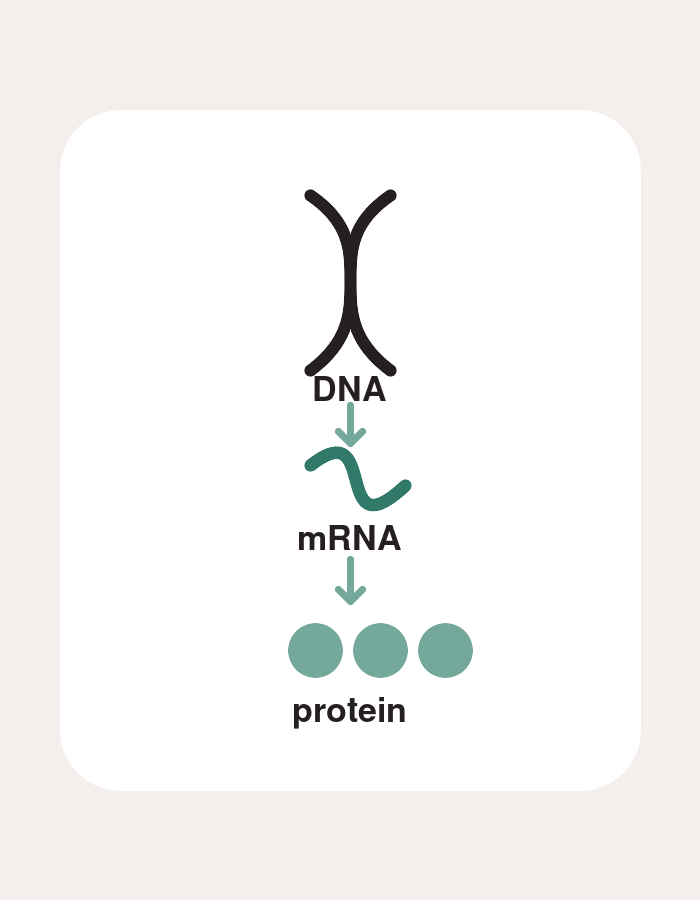
DNA is copied into mRNA; a ribosome reads it and joins amino acids into a protein. An injected mRNA recipe can enter this pathway without changing your DNA.
The lipid nanoparticle (LNP) protects fragile mRNA and helps deliver it into a cell. Delivery to the right cell type is a separate challenge.
An antibody is a protein that binds a specific molecular feature (often on another protein). It can flag a target, block it, or carry a drug payload.
Where the companies fit in pharma
This is the route a drug candidate takes, not a claim that either company has completed every step. Teal shows where their public platforms contribute today; the later stages belong to each specific drug program and its developer.
Scientists pick what biology to change, then make and test molecules that could do it.
Look for an effect and early safety signals; refine the molecule, delivery and manufacturing process.
The drug developer submits an IND in the US, with preclinical and manufacturing information. CMC means making and checking consistent batches.
Study safety and dose, then signs of benefit, then confirmatory evidence in larger studies. Many programs stop along the way.
A regulator reviews evidence for a specific drug and intended use. Passing a trial alone is not approval.
If approved, the sponsor scales supply and sales while tracking safety and performance after launch.
One specific therapy moves through the stages above. A tool provider's customer may own the later clinical program.
Discovery can start with a kit or paid research project, then grow into a platform option/license. Upfront and research fees arrive earlier; milestones and royalties depend on future events.
50 foundational terms
Each definition is a quick mental model, not a full scientific description. The numbers let you find a term again later.
01 / The cell's instruction manual
The tiny living unit that makes up your body.
Long-term genetic instructions kept in a cell.
A stretch of DNA with instructions for making a useful molecule, often a protein.
A family of molecules that can carry or help use genetic instructions.
Messenger RNA: a temporary copy of instructions a cell can read to make a protein.
A chain of amino acids folded into a working molecule. Insulin and antibodies are proteins.
One of the small building blocks linked together to make a protein.
The cell machinery that reads mRNA and builds a protein.
Copying DNA instructions into RNA.
Reading mRNA to assemble a protein.
02 / Delivery and mRNA drugs
The active cargo a delivery system carries, such as RNA or a drug.
A fat-like molecule; lipids can form protective delivery particles.
Lipid nanoparticle: a tiny fat-based package used to protect and deliver RNA.
Getting a drug or RNA into the cells where it needs to work.
Trying to send a payload to a particular tissue or cell type rather than everywhere.
Self-amplifying RNA: RNA designed to copy itself inside a cell, potentially making more protein from less starting RNA.
Production of a protein from a gene or an introduced RNA recipe.
The amount of a drug given at one time.
How a drug is packaged with other ingredients so it can be delivered and used.
In a living organism / outside one, such as in a dish.
03 / Antibodies and cancer tools
A protein that binds a particular molecular feature.
A substance or molecule that an antibody can recognize.
The specific patch on an antigen that an antibody binds.
The molecule or cell feature a therapy is designed to act on.
An antibody attaching to its target, like a matching grip.
How tightly a binding molecule holds its target.
A small antibody binding unit built from one variable domain.
The heavy-chain variable part of an antibody; Leveragen focuses on human VH-only binders.
An engineered antibody that can bind two different targets or sites.
Antibody-drug conjugate: an antibody joined to a drug payload to aim that drug at cells with a target.
04 / From lab to patient
A reusable technology used across multiple targets or drug programs.
The collection of drug programs a company is developing.
A promising molecule chosen for further testing, not yet an approved drug.
Testing before human trials, often in cells and animals.
A planned study in people to test a treatment.
Investigational New Drug application: the US filing that seeks permission to start testing a new drug in people.
Early human studies, focused mainly on safety and finding a suitable dose.
Studies that look for signs of benefit and continue assessing safety.
Larger studies that test benefit and safety to support a possible approval.
Chemistry, manufacturing and controls: how the drug is made, tested, and kept consistent.
05 / Business development and deal language
A packaged lab tool that scientists can buy to run experiments; not automatically a therapy.
Contract research organization: an outside company hired to perform research services.
Early data showing an idea works in a defined test, not proof it will work in patients.
Business development: finding, negotiating and managing commercial partnerships.
Permission to use someone else's technology or intellectual property under agreed terms.
A right, usually for a set time, to take a license later if agreed conditions are met.
Money paid when a deal is signed.
A payment triggered only if an agreed event happens, such as a trial or approval step.
A contracted share of future product sales if a product reaches the market.
The headline sum of possible future deal payments; most is conditional, not cash in hand.
The two companies
mRNA delivery and self-amplifying RNA platform. Think: the recipe plus a way to get it into selected cells. Its published cancer work is preclinical, not proof in people.
Antibody discovery using a human VH-only single-domain antibody mouse platform. A 2024 Moderna agreement covers research, options and licenses against Moderna-selected targets.
How the sale grows
Sources and scope
Simple mental models, not literal molecule shapes or medical advice. Company facts checked 27 Sep 2026.
Sources and further reading
- Deoxyribonucleic Acid (DNA) fact sheetNational Human Genome Research Institute, NIH
- Understanding COVID-19 mRNA vaccinesNational Human Genome Research Institute, NIH
- The drug development processU.S. Food and Drug Administration
- Step 3: Clinical research (IND and trial phases)U.S. Food and Drug Administration
- Antibody-drug conjugateNational Cancer Institute