Audit your judgment before AI flatters it
First published
Updated
Six-step workflow · forecasting research · safeguards
A six-step workflow for using AI to test your own decisions, and why the last step matters most.
Short answer
Record first, then let AI challenge you, then check the outcome
One AI critique can flag a possible bias. Only repeated comparisons of predictions with outcomes can show whether a pattern actually hurts your decisions.
The workflow below has six steps. Each is simple. The value comes from the order, and from returning to the record later.
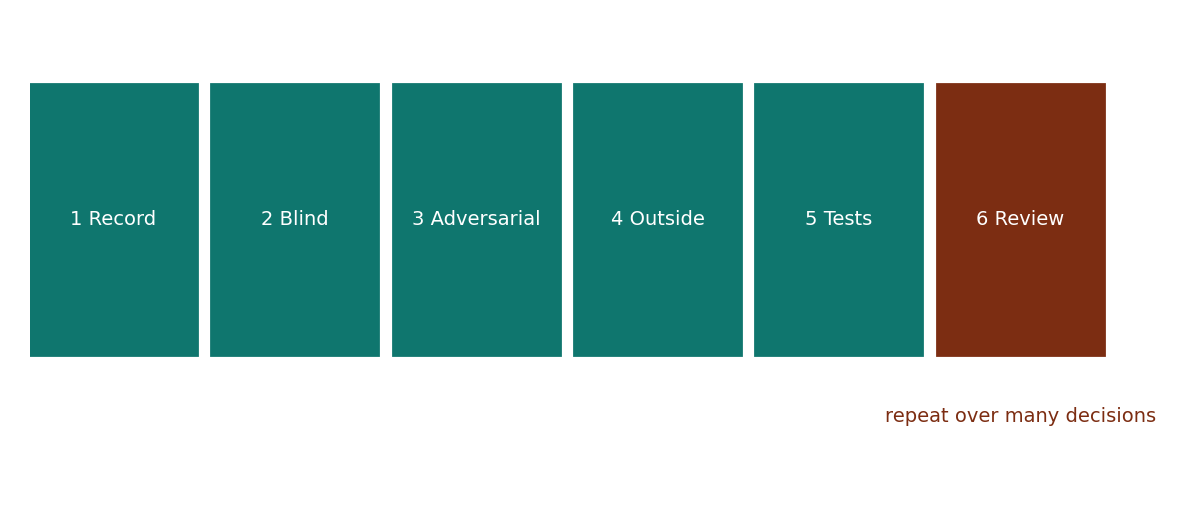
The workflow
Six steps, in sequence
- Record your original judgment. Before asking AI, write down the decision, your reasoning, your confidence and the outcome you want. In a classic study, people asked to recall earlier forecasts about President Nixon's trips later remembered probabilities that drifted toward what had happened (Fischhoff and Beyth, 1975). A written record is not subject to that drift. Numeric probabilities make later scoring possible; forecasting tournaments score such probabilities over time (Mellers and colleagues, 2015).
- Request a blind assessment. Give the AI the underlying evidence without your preferred conclusion and ask for the most plausible explanations. This matters because assistants trained on human feedback can lean toward a user's stated beliefs. One study found human and preference-model raters sometimes preferred agreeable responses over correct ones (Sharma and colleagues, 2023). That study documents the tendency in models then tested. It does not measure any particular assistant today, so treat the blind step as a precaution.
- Run an adversarial review. Now state your thesis and ask the AI to list unsupported assumptions, neglected alternatives, possible cognitive biases and evidence that would disprove it. This resembles the pre-mortem, in which a team imagines the plan has failed and explains why (Klein, HBR). Research on prospective hindsight found that explanations differ when an event is treated as certain rather than uncertain (Mitchell, Russo and Pennington, 1989), so the framing is worth setting deliberately.
- Compare against outside evidence. Ask for base rates, comparable cases, independent sources and what usually happens in similar situations. Kahneman and Lovallo describe an inside view that anchors on plans and scenarios and tends toward overly optimistic forecasts, and an outside view based on the statistics of past cases (Management Science, 1993). Check any base rate the AI supplies against its cited source, because a model can state a plausible figure without one.
- Convert disagreements into tests. Write down what additional evidence would change your mind and which outcome would separate the competing explanations. A disagreement with a date and an observable result can be settled. One without them usually cannot.
- Review predictions against outcomes. Return later and compare what you predicted with what happened, looking for recurring strengths and weaknesses. This step is essential. An AI can point to a possible bias in your reasoning, but a single case cannot show whether that pattern consistently hurts your results. That needs many observations, and even then the comparison should judge the quality of the decision, not only the result, since good decisions sometimes turn out badly and the reverse. Write your hypotheses down before looking at the record, test them on decisions made afterward, and compare with base rates and comparable cases.
Interactive: walk the six steps
Click through the workflow. Each step exists because of a specific failure mode of memory or of AI assistants.
Three questions
A short prompt for any decision
- What am I seeing that other people might be missing?
- What evidence suggests I might be fooling myself?
- What prediction or experiment would tell the difference?
The questions map onto the workflow. The first draws on your own judgment and is best written down at step 1. The second is the adversarial review at steps 3 and 4. The third is step 5, and its answer is what step 6 later checks.
Interactive: the three self-audit questions
Try them on a real pending decision. Checking a box maps the question to its place in the workflow.
Here is my decision and my reasoning. First, list my unsupported assumptions and neglected alternatives. Then argue the strongest case that I am wrong. Finally, tell me what evidence would distinguish between my thesis and yours.
Looking ahead
A possible next generation of decision support
What follows is a description of what such a tool could do. It is not a claim about any product available today.
Beyond a chatbot that critiques one document, an AI system could, with your permission, review your historical investment memos, meeting notes, forecasts, deal pipelines and decisions. Over time it could surface patterns for you to consider. The following are illustrations only, not findings about anyone:
- You consistently identify promising technical founders early, but your estimates of their fundraising timelines are overly optimistic.
- Your strongest investment judgments occur in markets where you have direct customer relationships, and they weaken when you rely mainly on secondary research.
- You have repeatedly rejected opportunities because of weak initial financial metrics even when customer retention signals were strong.
Each of these should be treated as a hypothesis to test against your actual records, not a conclusion about you. A well-designed system could evaluate hundreds of decisions consistently, without relying on selective memory. The aim is to turn personal experience into a testable and improving model of your own judgment. Whether such analysis is reliable would depend on the quality and completeness of the records, which is why step 1 comes first. Several safeguards would matter. Rejected deals and unresolved outcomes are often missing from the record, which can bias the picture. Markets change, so an old pattern may not hold. Many scored decisions do not by themselves establish cause. The system should state its hypotheses before testing them and check them on later decisions it has not seen. And the records may involve other people, so permission and who can see the results need to be settled first.
Takeaway
Do not try to eliminate every bias
Some things called biases are preferences, values or learned heuristics. Others are systematic errors. And some intuitive judgments contain useful information that is hard to articulate.
The task is to tell these apart. Kahneman and Klein, who started from opposing views, concluded that the quality of an intuitive judgment depends on how predictable the environment is and whether the person has had the opportunity to learn its regularities, and that subjective confidence is not a reliable guide to accuracy (American Psychologist, 2009). That supports using outcomes, not feelings, to decide which of your intuitions to keep.
Limits
What this workflow cannot do
- The cited studies cover specific tasks and populations. Applying them to investment decisions is the author's extension.
- The recording step relies on you being honest and consistent in what you write.
- Outcomes can be good or bad because of luck, so many decisions are needed before a pattern means anything, and a pattern found in past records can still be coincidence until it holds on new decisions.
- Records may leave out rejected opportunities and unresolved outcomes, and conditions change over time, so the record can give a partial or outdated picture.
Sources are linked inline. Drafted 24 Nov 2026 from the six steps, three questions and next-generation notes supplied by the requester.