AI shifts the skill premium rather than ending it
First published
Updated
Payroll data · field studies · early evidence
A hypothesis that the premium moves from doing technical tasks toward judging and combining them is consistent with parts of the early evidence. Most cited studies do not measure it directly.
Short answer
Both, and the split matters
My interpretation, not an observed result: the premium on technical skills is unlikely to rise evenly. Where AI substitutes for a technical task, the premium on doing that task may fall. Where technical skill is combined with judgment or other complements, the cited evidence on employment is more favorable. The cited studies measure productivity, employment and posted or realized wages, not the skill premium itself.
"Technical skills" covers two things: executing a defined task, such as writing routine code or running a standard analysis, and deciding what to build, whether the output is right and how it fits a business. The studies below mostly measure the first. Evidence on commercial judgment, relationship-building, capital formation and leadership specifically is thin, and this article says so where it applies.
Evidence on productivity and employment
Smaller productivity gaps and weaker early-career hiring
- In a study of 5,179 customer support agents, access to a generative AI assistant raised issues resolved per hour by 14% on average, including 34% for novice and low-skilled workers, with minimal impact on experienced and highly skilled workers. The authors give suggestive evidence that the tool spreads the practices of more able workers (Brynjolfsson, Li and Raymond, NBER w31161). This shows a narrower productivity gap between novice and experienced agents on one task in one firm. It does not measure wages or pay.
- A San Francisco Fed study finds coder employment growth slowed sharply after ChatGPT arrived, not explained by slowing industries, though coder employment kept growing, much more slowly than before (Crane and Soto, Apr 2026).
- Payroll data through June 2026 show, according to the authors, no widespread displacement, but employment of workers aged 22 to 25 in AI-exposed occupations stands 19% below that of a less-exposed comparison group on a relative basis. The authors test alternative explanations. A relative gap against a comparison group is not a measure of what employment would have been without AI. They report the gap runs mainly through reduced hiring, concentrates where AI usage mainly substitutes for human tasks, and is flat or rising where usage mainly complements workers (Brynjolfsson, Chandar and Chen, revised 12 Aug 2026).
Interactive: three numbers, three different claims
A productivity gain, a novice-expert gap and an employment gap measure different things. Click each bar.
Sources: Brynjolfsson, Li and Raymond (NBER w31161); Brynjolfsson, Chandar and Chen (revised 12 Aug 2026), as cited in the article.
Evidence that wages have not yet moved much
Early signs are mixed
- Danish administrative data show precise null effects of AI chatbots on earnings and recorded hours, ruling out effects larger than 2% two years after ChatGPT's launch. Work reorganized, with new tasks in AI oversight and integration, and adopters moved into higher-paying occupations where chatbots are more relevant (Humlum and Vestergaard, NBER w33777).
- A Cleveland Fed paper finds that job ads mentioning AI rose, and that more exposed occupations saw posted wages and hires rise relative to less exposed occupations, per the abstract (Rinz, Sep 2026).
- An IMF staff note finds that vacancies requiring AI skills post higher wages, and that new skills in general deepen polarization, mostly benefiting high-skilled and, through higher service consumption, low-skilled workers. It also links AI-skill diffusion to lower employment in occupations with high exposure and low complementarity to AI (IMF SDN/2026/001, Jan 2026).
Why complements could gain
What earlier evidence and theory say
David Autor argues that information is an input into decision-making, which is the province of elite experts, and that AI can extend the reach of expertise to a larger set of workers. He presents this as an argument about what is possible if AI is used well, not a forecast (Autor, NBER w32140). If more workers can do an expert task, the scarce input shifts toward whoever sets goals, checks results and carries accountability. That is an economic inference from the argument, not a result any cited study measures for AI.
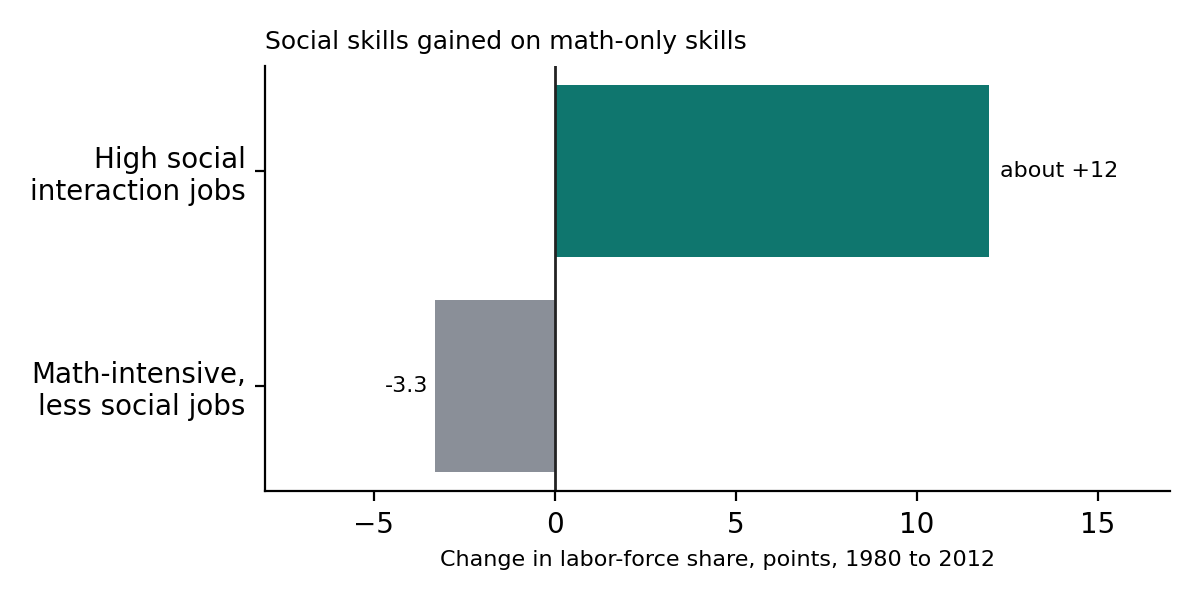
David Deming finds that between 1980 and 2012 jobs requiring high social interaction grew by nearly 12 percentage points of the U.S. labor force, math-intensive but less social jobs, including many STEM occupations, shrank by 3.3 points, and employment and wage growth was strongest for jobs requiring both math and social skill (Deming, NBER w21473). This predates generative AI. It shows that the market already paid for combinations of skills, which is consistent with, but not proof of, the same pattern continuing.
What the sources do not cover
Capital formation, relationships and leadership
The studies above measure tasks, occupations and wages. None measures the return to capital formation, relationship-building or leadership as AI spreads. Their link to the question is therefore reasoning, not evidence. One possibility is that these roles depend on trust, accountability and access, which may be harder for a model to substitute. AI can also assist commercial work such as research, drafting and analysis, so the net effect is open. A further caution is that AI exposure is itself measured imperfectly, and a widely cited measure finds higher-income jobs potentially more exposed to LLM capabilities than lower-income ones (Eloundou et al.).
How to tell which way it goes
Indicators to watch
- Wages and hiring by task type within the same occupation, separating execution-heavy roles from roles that combine execution with judgment or client responsibility.
- Entry-level hiring in exposed occupations. The payroll evidence above says the effect so far runs through hiring, so a lasting gap would mean the early-career pathway to judgment roles narrows.
- Productivity gaps, actual wages and the wage premium are three different things and need separate tracking. The support-agent study measures only the first: a narrower productivity gap between novices and experts. Whether wage premiums for execution skill follow is a separate question for wage data.
- Pay for roles that combine technical depth with commercial or leadership duties, relative to technical-only roles.
Interactive: four indicators that would settle it
Click each indicator to see what to watch and why it discriminates.
Limits
What remains uncertain
- Most evidence is early, from one to three years after generative AI spread, and from specific firms, countries and datasets.
- Several sources are working papers or staff papers, not peer reviewed.
- AI capability and adoption are changing, so tasks that complement humans today may be automated later.
- The article's reading is an interpretation of these studies, not a forecast.
Sources are linked inline. Figures checked 24 Nov 2026.